IELTSwithJurabek
Are you ready to begin your reading test?
Please wait
Are you ready to begin your reading test?
PASSAGE 1
Read the text and answer questions 1-13.
A Centuries before anyone ever heard of high-tech stocks such as Qualcomm, CMGI, or Cisco Systems, a tulip in 17th century Holland caused quite the stir. The Semper Augustus was a tulip of extraordinary grandeur, with midnight blue petals topped by a pure white band and highlighted with crimson flares. For the Dutch, there were few things more valuable than the Semper Augustus tulips.
B Around 1624, there were only a dozen specimens of the Semper Augustus. A man from Amsterdam owned all of the specimens. The man was offered 3,000 guilders in Dutch currency for just one bulb of the specimen. At the time, that was an absurd amount. The well-known Dutch painter Rembrandt Harmenszoon van Rijn received only about half of that amount a few years later for his The Night Watch painting. Despite the apparently exorbitant offer for just one of his tulip bulbs, the Dutch man, whose name has been lost in history, declined the offer.
C At that time, people wondered who was wackier, the man who refused to sell a tulip bulb for a fortune or the man who had offered to pay a fortune for just one bulb. This question was explored extensively by British journalist Mike Dash in his book, The Story of the World's Most Coveted Flower and the Extraordinary Passions It Aroused. In his account of tulip mania, Dash details the history behind the buzzword and, in doing so, he presents a cautionary tale for modern-day investors, who are often inclined to load up on unproven and yet-to-be-profitable stocks, similar to the tulip mania that raged in Holland in the 17th century.
D It should be pointed out that the Dutch were not the first people to go bonkers over tulips. Long before the first tulips ever bloomed in Europe, the Persians had already fallen in love with the beauty of the flower, and the rulers of the Ottoman Empire held it in the highest regard, dating back to a time around 1559. However, when the tulip finally arrived in Holland, the flower seemed to find an even more fertile ground, and not just from a horticultural standpoint.
E In the early 17th century, Holland was entering its Golden Age. Time, energy, and financial resources that had previously been used in fighting for Holland's independence from Spain were now available to be used for commerce. The city of Amsterdam was the hub of lucrative trade with the East Indies and a single voyage to the East Indies could result in substantial profits for the merchants involved in those activities. Those merchants often flaunted their success by building great estates, many landscaped with magnificent flower gardens.
F Then along came the tulip. "It is impossible to comprehend the tulip mania without understanding just how different tulips were from every other flower known to horticulturists in the 17th century. The colours they exhibited were brighter than those of ordinary plants," Dash explains. Although the rarer tulips sometimes commanded higher prices, the bulbs for most ordinary tulips were sold by the pound for a modest price. Then, around 1630, a different type of tulip fancier appeared on the scene. Motivated by thoughts of great profits, these "florists" or professional tulip traders set out to find flower enthusiasts and speculators alike. But even as the number of tulip buyers grew quickly, the supply of tulip bulbs remained stagnant. It seems that the tulip became a foil in the supply squeeze: there was no quick fix to increase the quantity of available bulbs, as it takes seven years for a tulip to grow from a seed. Even though bulbs can produce two or three offshoots annually, the mother bulb lasts only a few years.
G Tulip bulb prices continued to soar throughout the 1630s, as more speculators wedged into the market. Even people in other occupations wanted in on the tulip trading business. Weavers and farmers mortgaged their assets in order to get into the tulip market. In 1633, a farmhouse in Hoorn was sold in exchange for three rare bulbs. By 1636, the tulip trading business was flourishing so much that even "garbage" bulbs were being sold for hundreds of guilders. Eventually, a futures market for bulbs was even established. Tulip mania reached its zenith during the winter of 1636-1637, when some bulbs were known to be bought and sold up to ten times a day. Exemplifying this mania is the story of an auction that was held to benefit seven orphans whose only asset was 70 fine tulips left by their father. One of those bulbs, a rare Violetten Admirael van Enkhuizen bulb, sold for 5,200 guilders, an all-time record. All told, the 70 flowers from that auction brought in nearly 53,000 guilders.
H There is a saying that goes, "All good things must come to an end." That was certainly the case with the tulip market, which crashed quickly and spectacularly. It wasn't long after the above-mentioned orphan auction, when buyers refused to pay high asking prices at a routine bulb auction in Haarlem. In just a matter of days, the word of this auction spread all over the country, creating widespread panic among tulip traders and speculators. And, sure enough, the market for tulips crashed quickly thereafter. Tulips that had sold for 5,000 guilders only a few weeks before now fetched only 50 guilders.
I In comparing the tulip mania of the 17th century with the recent dot-com craze, there is one major difference: even at its height, the Amsterdam Stock Exchange never touched tulips. "The speculation in tulip bulbs always existed at the margins of Dutch economic life," Dash points out. As tulip trading was at the periphery of the Dutch economy, the fallout had little effect on the Dutch economy. Will we be able to say the same when Wall Street's current obsession with the dot-com craze finally runs its course?
Reading Passage 1 has nine paragraphs A-I.
Which paragraph contains the following information?
Choose the correct letter A-I, in boxes 1-5.
| Statement | A | B | C | D | E | F | G | H | I |
|---|---|---|---|---|---|---|---|---|---|
| 1 a reference to an individual who warned of the dangers of investing | |||||||||
| 2 a description of the outstanding appearance of a famous tulip | |||||||||
| 3 a reference to another society fascinated by tulips | |||||||||
| 4 a reference to the highest price offered at an auction | |||||||||
| 5 an incident related to the ending of 'tulip mania' |
Choose TRUE if the statement agrees with the information given in the text, choose FALSE if the statement contradicts the information, or choose NOT GIVEN if there is no information on this.
Write ONE WORD ONLY from the passage for each answer.
PASSAGE 2
Read the text and answer questions 14-26
A Like a passenger train, a roller coaster consists of a series of connected cars that move on a track. But unlike a passenger train, it has no engine or power source of its own. For most of the ride, it is moved only by the forces of inertia and gravity. The only exertion of energy occurs at the very beginning of the ride when the coaster train is pulled up the lift hill.
B The traditional lifting mechanism is a long length of chain running up the hill under the track. The chain is fastened in a loop, which is wound around a gear at the top of the hill and another one at the bottom of the hill. The gear at the bottom of the hill is turned by a motor. This turns the chain so that it continually moves up the hill like a long conveyor belt. The coaster cars grip onto the chain, which simply pulls them to the top of the hill. At the summit, the train is released and starts its descent.
C The purpose of this initial ascent is to build up a sort of reservoir of potential energy, which simply means that as the coaster gets higher in the air, there is a greater distance gravity can pull it down.
D As the train starts coasting down the hill, this potential energy is converted into kinetic energy (energy of motion), and the train speeds up. At the bottom of the hill, this has reached its maximum, and this propels the train up the second hill, again building up the potential energy level.
E In this way, the course of the track is constantly converting energy from kinetic to potential and back again. This fluctuation in acceleration is what makes roller coasters so much fun. At its most basic level, this is all a roller coaster is – a machine that uses gravity and inertia to send a train along a winding track.
F Roller coasters have a long, fascinating history. Their direct ancestors were ice slides, popular in Russia in the 16th and 17th centuries. They consisted of a long, steep, wooden slide covered in ice. Riders walked up a ladder or set of stairs to the top of the slide, as high as 21 meters up. At the top, they climbed into sleds made out of wood or blocks of ice and shot down the slope. At the base of the slide, the sleds would crash-land in a sand pile.
G It seems that the idea was then imported into France. For most of the year, the warmer climate would melt the ice, so the French started building waxed slides instead. To help the sleds move down these slides, they added wheels, and in 1817, for the first time, a train was attached to the track. The French continued to expand on this idea, coming up with more complex track layouts, with multiple cars and all sorts of twists and turns.
H The first American roller coaster was built in the mountains of Pennsylvania in the mid-1800s originally to provide an easy way to send coal to the railway 29 km down the mountain. When the track was first built, a crew at the bottom of the mountain would attach the cart to a team of mules after emptying the load, and the mules would drag it back up to the top. They were eventually replaced with steam engines, to make the system more efficient.
I Soon after these improvements were made, the railway company built a new tunnel that brought the freight trains much closer to the coal mine. Now no longer required for its original purpose, the roller coaster was configured as a 'scenic tour'. For one dollar, tourists got a leisurely ride up to the top of the mountain, followed by a wild, bumpy ride straight down. This was soon a resounding success, attracting thousands of tourists every year.
J Scenic rides like this continued to thrive and were joined by wooden roller coasters similar to the ones we know today. These coasters were the main attraction at popular amusement parks throughout the United States, such as the many parks of Coney Island in New York. By the 1920s, roller coasters were in full swing, with some 2,000 rides in operation around the country. Following the Great Depression, a decline in roller coaster production began in the early 1930s but a second roller-coaster boom in the 1970s and the beginning of the 1980s revitalized the amusement park industry, and introduced a slew of innovative tubular steel coasters.
K This was followed by a decline in interest for the rest of the decade, but since the early 1990s the amusement-park industry has experienced another coaster boom of sorts. New launching techniques and other technological developments have opened up a world of options for designers so in some rides you feel as if you are flying. In the next few years we can expect to see many faster, taller and more twisted rides popping up in amusement parks around the world.
Label the diagram below. Write ONE WORD ONLY.
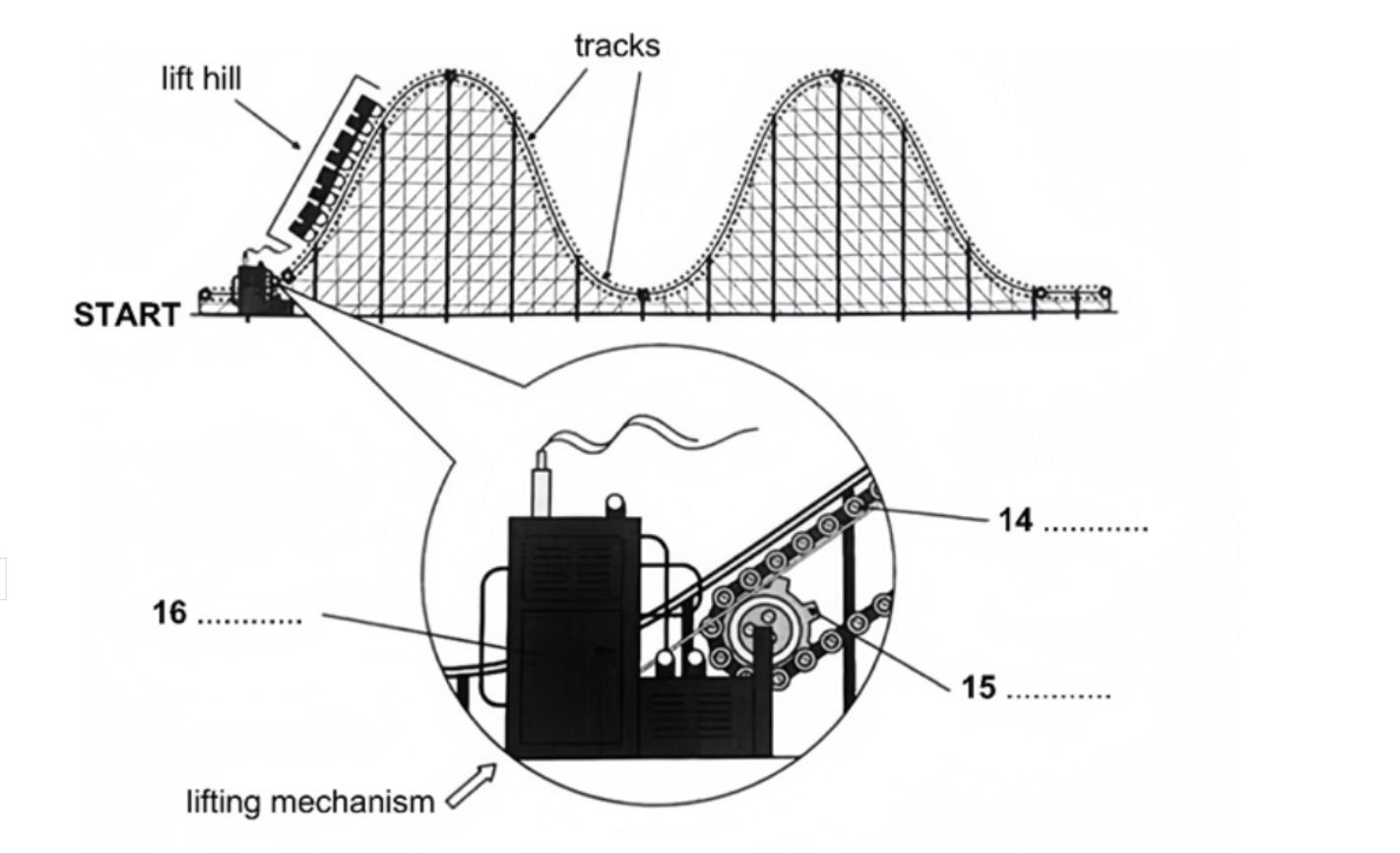
| Question | Answer |
|---|---|
| 14 | |
| 15 | |
| 16 |
Complete the summary. Write NO MORE THAN TWO WORDS.
Modern roller coasters are descended from 16th-century Russian slides with a surface of . People climbed to the top, and travelled down in sleds. In France, because of the higher temperatures, the wooden surface on the slides was and were attached to the cars to ease the descent. The first US roller coaster was used for transporting down a mountainside in carts. Initially, these were pulled by mules but in time power was produced by .
Choose TRUE, FALSE, or NOT GIVEN.
READING PASSAGE 3
You should spend about 20 minutes on Questions 27-40, which are based on Reading Passage 3 below.
A As an eighteen-year-old living in the small Australian island state of Tasmania, moving to the 'mainland' could not happen soon enough. Now, ten years later, I look forward to going home. This is probably because I've grown up, but also perhaps because the cultural landscape of Tasmania has matured. The latest addition to Tasmania's cultural scene is David Walsh's Museum of Old and New Art (MONA), a museum that has established Hobart, the capital city of Tasmania, on the global art circuit.
B This building is an example of how art and architecture can have an instant impact on the social and cultural reputation of a place. Andrew Bain of The Sydney Morning Herald wrote, 'In a virtual blink, Hobart's cultural landscape has been transformed, with art, wine, fine food and stylish accommodation becoming integral features of the city.... If Hobart's makeover has an origin, it's the opening of MONA - the Museum of Old and New Art.' MONA is said to have been solely instrumental in the reinvention of Hobart as a cultural hub.
C MONA made the national press and international blogs before it opened. After that, Tourism Industry Council of Tasmania's chief executive, Luke Martin, claimed that MONA was proving so popular it was underpinning the tourism industry in Tasmania. However, MONA's effect on Hobart has broader ramifications for Tasmania's tourism industry. As reported in Hobart's local paper, The Mercury, there is concern about how long people are staying in Tasmania. Rather than spending a week in the state and hiring a car to experience the beauty of the Tasmanian landscape, people are making short stays in Hobart only to visit the gallery. The next challenge for the state is how to entice holiday makers to stay longer, and to venture further afield. Tasmania is more than a one-hit wonder.
D According to Martin, possibilities for packaging up MONA with visits to other galleries around Tasmania are being investigated. Although not directly related to these investigations, the 1891 Queen Victoria Museum and Art Gallery at Royal Park in Launceston is currently being restored to its original condition; there are also plans to extensively redevelop the Tasmanian Museum and Art Gallery in Hobart. In addition to this, there are up to twenty other existing quality galleries in the state. So there is more to see than just MONA.
E Although large, the building is rather nondescript, sitting heavily on the edge of the Derwent River. MONA's 'wow factor' comes from the notoriety of David Walsh, the museum's millionaire founder, and his choice of unusual artworks. The architecture has more depth of meaning and does exactly as it should: it supports the vision of the museum, essentially the vision of Walsh. It's a new building in the context of a maturing city. The dark, moody labyrinth of gallery spaces could be likened to the mind of the eccentric founder himself. Each artwork appears to be integrated into the dark materiality of the architecture - the interiors are far from light, bright and neutral, as might be seen in a more traditional gallery. The dim lighting and rough, rocky surfaces are a reminder that visitors are three levels underground.
F The warped, mirrored surface at the museum's entry could be seen as the start of a journey of reflecting on one's existence. Much of the art explores the human condition - there are uninhibited artistic descriptions of human relationships, death, and even the digestion process. Going to a gallery with such confronting artworks with your parents is an interesting experience; I was pleasantly surprised by my parents' openness to the exhibitions. My father, who normally whisks through a gallery while my mother likes to take her time, happily spent almost five hours at MONA; the urge to linger is a common feeling here. This is because the gallery engages all of the senses, and visitors often pause to experience the effect each artwork has on them. This raises the question of who is actually visiting MONA - and it's definitely not just the normal gallery-goers. People from all kinds of socioeconomic backgrounds are curious about what lies within the subterranean maze of MONA. Conservative minds are being opened, which is a good thing anywhere.
G Walsh's antiquities collection is superb, but he knew that old coins would compete for attention against new works that are more challenging in scale and subject matter, hence the device of setting antiquities among twentieth-and twenty-first century works. For me, one of the intriguing outcomes of this strategy was an intensified feeling that the makers of the coins and antiquities were the great contemporary artists of their time.
H The so-called Bilbao Effect has worked its magic on Hobart because, just as Frank Gehry's Guggenheim Museum has transformed the city of Bilbao in Spain, MONA has been a magnet for tourists in Hobart. However, the architectural 'wow factor' of the Guggenheim was the most famous component of that city's transformation, whereas Fender Katsalidis's MONA does not have the same spectacular impact as the shimmering metal surfaces of Gehry's building. Walsh himself abhors descriptions of MONA as the Bilbao of the south, saying that Fender Katsalidis solved a problem when he designed MONA, in executing a project of this scale in an underground location. Walsh contrasts this with what he describes as the 'architectural self-indulgence' of Gehry when designing the Guggenheim in Bilbao. Call it the Bilbao Effect, but this phenomenon has been around for thousands of years - good public architecture forms the centrepiece of a city. This is probably true, but like the Guggenheim, MONA has initiated something very important for Tasmania, and for Hobart in particular. Now the question is how Tasmania will build on David Walsh's input into its cultural setting.
Choose YES if the statement agrees with the claims of the writer, choose NO if the statement contradicts the claims of the writer, or NOT GIVEN if it is impossible to say what the writer thinks about this.
27 The writer changed her mind about spending time in Tasmania.
28 Andrew Bain believes that the effect MONA had on Hobart was immediate.
29 Other factors have contributed as much as MONA to Hobart's transformation.
30 The Tourism Industry Council of Tasmania works closely with the director of MONA.
31 Many local residents are writing to The Mercury expressing concern about tourists' length of stay in Hobart.
32 Tourists now regard MONA as a starting point for longer trips in Tasmania.
Choose the correct answer.
33 Luke Martin plans to promote tourism in Tasmania by
34 According to the writer, what is especially interesting about MONA?
35 Why do visitors spend a long time at the gallery?
36 What does the writer say about the visitors to MONA?
37 Why does the writer mention the coins at MONA?
Complete the summary below.
Complete the summary using the list of words, A-H, below.