IELTSwithJurabek
Are you ready to begin your reading test?
Please wait
Are you ready to begin your reading test?
PASSAGE 1
Read the text and answer questions 1-13.
The decades following photography's experimental beginnings in the 1820s and the public availability of a practical photographic process from 1839 were characterized by the introduction of a wide number of photographic processes. The following are a few of the most significant.
Announced in Paris in 1839, the daguerreotype was the first publicly available photographic process. The daguerreotype image was created on a silvered metal plate exposed to iodine fumes, forming a light-sensitive surface of silver iodide. Development was achieved by exposing the plate to fumes of heated mercury and then fixing the image in a salt solution. The daguerreotype produced remarkably sharp pictures, but unlike competing processes, each daguerreotype was unique. This proved to be its major drawback, compared to other processes from which unlimited copies could be made.
One of the oldest and longest surviving photographic processes, the cyanotype or blueprint, was invented by Sir John Herschel in 1840, using a mixture of ferric ammonium citrate and potassium ferricyanide to produce a light-sensitive paper. As a relatively simple process to prepare and manipulate - it required no development or fixing other than washing - it was popular among amateurs throughout the nineteenth century and has also been widely used by engineers and architects for reproducing technical drawings (blueprints).
William Henry Fox Talbot's calotype process, the first practical negative-positive photographic process, was patented by him in 1841. A sheet of good quality paper was first treated with light-sensitive silver compounds before exposure in the camera. This produced an image in reverse, known as a negative, which was then developed in gallo-nitrate of silver and fixed. This concept of photography, allowing the production of an unlimited number of prints from a single image, has formed the basis of photographic practice until recently, when it started being challenged by digital imagery. The calotype negative was the subject of many refinements in the 1840s and 50s, and it was common practice for photographers to apply heated wax in order to increase printing transparency and lessen the visibility of the paper fibres.
Frederick Scott Archer's wet collodion process, announced in 1851, became the standard photographic process for both amateurs and professionals from the mid-1850s until the early 1880s. The process proved immediately popular, and within a decade had superseded both the daguerreotype and the calotype processes. To prepare the negative for exposure, a sheet of glass was coated with a solution of iodised collodion (a syrupy liquid composed of soluble gun-cotton, ether and alcohol) and then made light-sensitive by immersion in a bath of silver nitrate. Known as a wet process because the glass negative required sensitising, exposing and processing while the chemicals were still damp, it required significant skill to manipulate, but produced a negative of unsurpassed sharpness and a broad tonal range.
The albumen print, announced by the French photographer and publisher Louis-Desire Blanquart-Evrard in 1850, was the most widespread print medium in use between the mid-1850s and the 1890s. While the printing process was chemically similar to an earlier process which was called the 'salted paper process,' the albumen print was generally distinguishable by the glossy sheen imparted by a preliminary sizing of the paper with albumen (egg white) and salt. After the albumen coating had been applied, the paper was made light sensitive by the addition of silver nitrate and printed in contact with the negative. The fixed print could then be toned to create a wide variety of colours, ranging from purple-black to a rich chocolate brown. Although it continued to be used well into the twentieth century, its popularity declined after the mid-1890s, in favour of a variety of manufactured papers.
The fact that all silver-based photographic images tended to fade was a source of concern from the earliest days of photography, and considerable research was carried out in attempts to produce permanent images. Perhaps the most successful of these was the carbon process. First patented by A. L. Poitevin in 1855, the process utilised the fact that gelatin mixed with an alkaline bichromate becomes insoluble when exposed to light. When printing from a negative, those parts of the image representing shadow tones were hardened by the exposure to light, while light areas, protected from exposure, remained unhardened and could be subsequently washed away. Carbon and other pigments could be used as colouring agents to obtain an almost unlimited range of tones in the final image. Because the process does not employ compounds derived from silver, the resulting image is less likely to fade and was widely used in book illustration in the 1870s and 1880s.
Complete the table below.
Write ONE WORD ONLY from the passage for each answer.
| Process | Advantage | Disadvantage |
|---|---|---|
| daguerreotype | images were very | each image was |
| cyanotype | was comparatively to use | |
| calotype | first process which created an image called , from which unlimited copies could be made | |
| wet collodion process | produced high-quality images | needed considerable to use |
| albumen print | produced glossy images in a range of | |
| carbon process | produced permanent images because it did not use any products based on |
Choose TRUE if the statement agrees with the information given in the text, choose FALSE if the statement contradicts the information, or choose NOT GIVEN if there is no information on this.
PASSAGE 2
Read the text and answer questions 14-26
A It's one of our most powerful medical treatments, and certainly our most widely effective. In recent years, it's been found to help eliminate or lessen the symptoms associated with clinical depression, irritable bowel syndrome, panic attacks, coughing, and ADHD, among other conditions. This name of this wonderful treatment? It's the 'placebo effect,' the remarkable power of the human brain to unconsciously influence the functioning and perception of the body.
B The term, which is Latin for 'I shall please,' was first used sometime during the 1700s, but the concept itself dates back centuries. Historically, doctors believed that one of their key duties, in addition to curing a patient, was to console him or her, providing a boost to the morale that could help them to get better faster - sometimes in the form of a dummy medicine that had no effect beyond instilling the expectation of improvement in the patient's brain. It's now widely recognized that, while largely ineffective in improving objective symptoms, such as high blood pressure or an infection, for instance, placebos are genuinely effective in treating subjective, self-reported symptoms, including all sorts of pain. Placebos can take all sorts of forms: inert sugar pills, sham surgeries, and saline injections.
C The singular power of expectations has been demonstrated in a variety of studies. In one, for example, patients given a placebo pill that is referred to as a muscle relaxer will experience muscle relaxation, while those given a placebo called a muscle stimulator will experience muscle tension. The flip side of the placebo, the nocebo effect, is just as powerful - negative expectations can cause as much harm as positive ones can do good. In other studies, it's been shown that pills which are red, yellow, or orange in color are more likely to provide a stimulating effect, while blue and green ones are more often perceived as sedating. One study even found that bigger pills are better when it comes to placebo performance.
D The science that underlies all of these studies isn't well understood at this point. Scientists have conducted some imaging research into the brain on placebos, and they've found that ingestion of a placebo billed as a painkiller leads to increased activity in several areas of the cerebral cortex, as compared to an actual painkiller. These areas are involved in so-called 'higher' functions like memory, attention, thought, and consciousness. A pain-killing placebo, it seems, works differently from a painkiller.
E In a recent headache study, conducted by researchers at Harvard Medical School, 66 participants who suffer from chronic migraines were given six envelopes, each containing a pill to be taken after their next migraine attack. Two envelopes were labelled 'Maxalt' - the brand name for the widely used migraine drug rizatriptan - in order to generate positive expectations, while two had no label, to produce neutral expectations, and two were labelled 'placebo,' to generate negative expectations. But for each of the three labels, one envelope held a genuine rizatriptan pill, and one contained a placebo. This allowed the researchers to cross-compare the effectiveness of rizatriptan + positive expectations, rizatriptan alone, and rizatriptan + negative expectations, as well as positive, neutral, and negative expectations in isolation.
F When the scientists analyzed the participants' self-reported pain reductions after taking the pills, the power of the placebo was proven yet again. People who'd taken a placebo pill labelled Maxalt got just as much pain relief as those who'd taken a Maxalt pill labelled as a placebo. Additionally, people who took a Maxalt correctly labelled as Maxalt reported about twice as much pain reduction as those who took a Maxalt pill labelled as placebo. In other words, in treating a complex, chronic form of pain like migraine, the effectiveness of pure expectations was roughly equal to the effectiveness of the pharmaceutical itself.
G For a doctor, harnessing the placebo's power doesn't mean intentionally mislabelling pills. Instead, a doctor could simply provide a slightly more positive message about a treatment, lending the power of expectations to that of pharmaceuticals. "When doctors set patients' expectations high, Maxalt becomes more effective," lead author of the study Rami Burstein said in a press statement. Of course, this sort of intentional expectation-setting needs to be done carefully. Doctors have an ethical obligation not to mislead patients or withhold important information. But that doesn't mean that making sure to provide subtle positive cues about the effectiveness of a medication - especially when those very cues might well make it work more effectively - is a bad idea. As Ted Kaptchuk, one of the study's co-authors, put it, "the placebo effect is an unacknowledged partner for powerful medications."
The text has seven paragraphs, A-G.
Which paragraph contains the following information?
Choose the correct letter, A-G, in boxes 14-17 below.
NB You may use any letter more than once.
| Information | A | B | C | D | E | F | G |
|---|---|---|---|---|---|---|---|
| 14 An explanation of the neurological process by which placebos work | |||||||
| 15 The origin of the word 'placebo' | |||||||
| 16 A recommendation as to how medical professionals can take advantage of the placebo effect | |||||||
| 17 Mention of how the appearance of placebos can affect how well they work |
Complete the sentences below.
Write ONE WORD ONLY from the passage for each answer.
Choose TWO correct answers.
Which TWO findings were observed in the Harvard Medical School study?
Read the text and answer questions 27-40
Could the vast towers of mud constructed by insects in sub-Saharan Africa hold the key to our energy-efficient building of the future?
A 27 To most of us, termites are destructive insects which can cause damage on a devastating scale. But according to Dr Rupert Soar of Loughborough University’s School of Mechanical and Manufacturing Engineering, these pests may serve a useful purpose for us after all. His multi-disciplinary team of British and American engineers and biologists have set out to investigate the giant mounds built by termites in Namibia, in sub-Saharan Africa, as part of the most extensive study of these structures ever taken.
B 28 Termite mounds are impressive for their size alone; typically they are three metres high, and some as tall as eight metres by found. They also reach far into the earth, where the insects ‘mine’ their building materials, carefully selecting each grain of sand they use. The termite's nest is contained in the central cavity of the mound, safely protected from the harsh environment outside. The mound itself is formed of an intricate lattice of tunnels, which spilt into smaller and smaller tunnels, much like a person’s blood vessels.
C 29 This complex system of tunnels draws in air from the outside, capturing wind energy to drive it through the mound. It also serves to expel spent respiratory gases from the nest to prevent the termites from suffocating, so ensuring them a continuous provision of fresh, breathable air. So detailed is the design that the nest stays within three degrees of a constant temperature, despite variations on the outside of up to 50 ℃, from blistering heat in the daytime to below freezing on the coldest nights. The mound also automatically regulates moisture in the air, by means of best its underground ‘cellar’, and evaporation from the top of the mound. Some colonies even had ‘chimneys’ at a height of 20m to control moisture less in the hottest regions of sub-Saharan Africa.
D 30 Furthermore, the termites have evolved in such a way as to outsource some of their biological functions. Part of their digestive process is carried out by a fungus, which they ‘farm’ inside the mound. This fungus, which is found nowhere else on earth, thrives in the constant and optimum environment of the mound. The termites feed the fungus with slightly chewed wood pulp, which the fungus then breaks down into a digestible sugary food to provide the insects with energy, and cellulose which they use for building. And, although the termites must generate waste, none ever leaves the structure, indicating that there is also some kind of internal waste-recycling system.
E 31 Scientists are so excited by the mounds that they have labelled them a ‘super organism’ because, in Soar’s word. ‘They dance on the edge of what we would perceive to cool down, or if you’re too cold you need to thrive: that’s called homeostasis. What the termites have done is to move homeostatic function away from their body, into the structure in which they live.’ As more information comes to light about the unique features of termite mounds, we may ultimately need to redefine our understanding of what constitutes a ‘living’ organism.
F 32 To reveal the structure of the mounds, Soar’s team begins by filling and covering their plaster of Paris, a chalky white paste based on the mineral gypsum, which becomes rock-solid when dry. The researcher's team carves the plaster of Paris into half-millimetre-thick slices, and photograph them sequentially. Once the pictures are digitally scanned, computer technology is able to recreate complex three-dimensional images of the mounds. These models have enabled the team to map termite architecture at a level of detail never before attained.
G 33 Soar hopes that the models will explain how termite mounds create a self-regulating living environment which manages to respond to changing internal and external conditions without drawing on any outside source of power. If they do, the findings could be invaluable in informing future architectural design, and could inspire buildings that are self-sufficient, environmentally, and cheap to run. ‘As we approach a world of climate change, we need temperatures to rise,’ he explains. ‘There will not be enough fuel to drive air conditioners around the world.’ ‘It is hoped,’ says Soar, ‘that the findings will provide clues that aid the ultimate development of new kinds of human habitats, suitable for a variety of arid, hostile environments not only on the earth but maybe one day on the moon and beyond.’
Choose the correct heading for each paragraph.
Complete the diagram. Write ONE WORD ONLY.
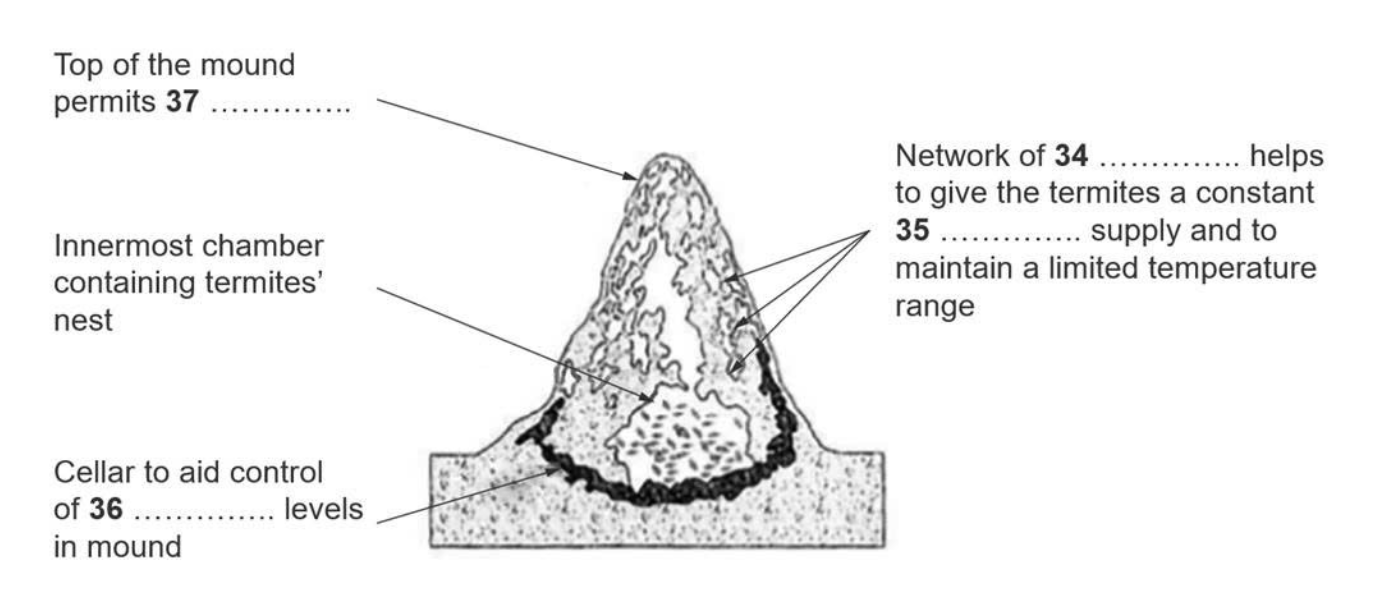
| Question | Answer |
|---|---|
| 34 | |
| 35 | |
| 36 | |
| 37 |
Choose YES, NO, or NOT GIVEN.