 IELTSwithJurabek
Are you ready to begin your reading test?
Please wait
IELTSwithJurabek
Are you ready to begin your reading test?
IELTSwithJurabek
PASSAGE 1
Read the text and answer questions 1-13
Inventor of the Seed Drill
The English gentleman farmer who revolutionised the practice of agriculture
A Jethro Tull was a major pioneer in the modernisation of agriculture. He was born in 1674 in Berkshire, southern England, into a family of land-owning gentry. He studied first at Oxford University and then at the Inns of Court, London, in preparation for a legal or political career. However, ill health caused him to postpone these plans, and after qualifying as a barrister in 1699, he made a tour of Europe, in the hope that the milder climates of France and Italy would alleviate his breathing problems. In every country through which he passed, he made careful observations of the soil and agricultural production, and on his return to England, the young Tull married, then began farming with his father at Howberry Farm in Oxfordshire.
B Tull was determined to improve farming methods and increase crop yield on the family land, and pursued a number of agricultural experiments there. He particularly wanted to increase efficiency in the sowing of seeds. At that time seeds were still thrown by hand across the field in a haphazard manner, in a traditional method known as broadcasting. Tull soon realised this method of random distribution was inefficient, being wasteful of both seed and labour, so he instructed his staff to sow seeds at very precise, low densities. But by 1701, his frustration with their lack of co-operation prompted him to invent a machine to do the work for him.
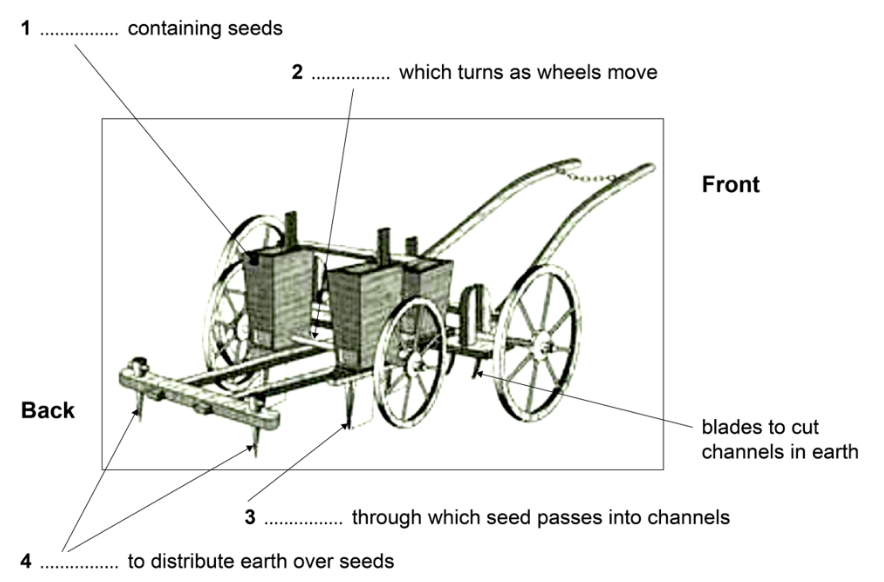
C Earlier in his life, Tull had once dismantled a pipe-organ, and the application of the technology behind this musical instrument inspired him to devise a drill that would distribute precise amounts of seed into pre-cut channels. Basic seeding devices had been known for almost 2000 years, but Tull took the concept a stage further. In his device, as the main wheels of the drill turned, the cylinder rotated against a spring-held tongue. This allowed seed to pass evenly from the hopper above to a funnel below. From here, the seed was directed at regular intervals into three channels, or furrows, in the earth. These were dug to a specific depth by the blades at the front of the machine. Spikes at the back of the machine then turned the soil over to immediately cover the seeds. Tull's 'seed drill' would limit the wastage of seed, and as the seedlings grew in uniform rows, it would also make it easier to remove any unwanted weeds growing among the crop. Accordingly, each plant would have more space to grow, and although there would be fewer plants, the net yield would be greater.
D Initially the machine was only a limited success, and in 1711 Tull decided to travel around Europe again, both to improve his health and to study agricultural techniques there. Upon his return in 1714, he perfected both his system and machinery. Following practices he had observed in the vine-growing methods of southern Europe, he used an animal-drawn hoe to turn over and pulverise the earth between the rows. He wrongly believed that this practice would release enough nutrients in the soil to nourish the crop, and so eliminate the need for manure to be used to fertilise the soil. His experiments were apparently successful, as he did manage to grow wheat in the same field for 13 successive years without the use of manure. However, it is more likely that it was the turning over and pulverisation of the soil that cut down on the volume of weeds competing with the seed.
E Tull's complete system eventually proved to be a major influence in the agricultural revolution, and its impact can still be seen in today's methods. Most subsequent drilling and hoeing implements have been either copies of, or improvements upon his inventions, and his modifications to the basic model of the plough continue to be visible in modern versions. Tull also advocated the use of horses over the oxen, more traditionally used to pull farm machinery, and published a book in 1731 outlining this and other ideas to enhance agricultural efficiency. The book caused great controversy when it appeared, and resistance to his revolutionary theories persisted for many decades. Another century would pass before his eventual vindication. It was only following the editing of his writings in 1822, and the subsequent translations and acceptance in France, that Tull's ideas finally achieved recognition in his native land. Although in his lifetime Tull's methods and inventions were dismissed and ridiculed, they were gradually adopted by large landowners, and in time, came to form the basis of modern agriculture.
Label the diagram below. Write ONE WORD ONLY from the passage for each answer.
Jethro Tull's seed drill
Complete the sentences below. Write NO MORE THAN TWO WORDS from the passage for each answer.
What name was given to the traditional technique of seed-sowing?
What type of agriculture gave Tull inspiration on his second tour of Europe?
What traditional addition to soil did Tull believe to be unnecessary?
What animals did Tull recommend farmers should use to pull their machinery?
Choose TRUE if the statement agrees with the information given in the text, choose FALSE if the statement contradicts the information, or choose NOT GIVEN if there is no information on this.
PASSAGE 2
Read the text and answer questions 14-26
Each of our cells has an internal 'clock' which dictates our daily rhythms. But why?
A From buffalo to bacteria, oaks to algae, all life follows the same relentless 24-hour cycle, which is driven by the rising and setting of the Sun. Or is it? Over 250 years ago, a French scientist performed a simple experiment that blew apart the idea that all life on Earth does the bidding of the Sun. Intrigued by the way some flowers open and close their leaves each day, Jean-Jacques de Mairan put a heliotrope in a darkened room and observed the effect. He was expecting the plant, robbed of sunlight, to cease its daily routine. To his astonishment, its leaves continued to open and close as if in response to some invisible timekeeper.
B But what - and where - is this internal timekeeper? And how does it achieve such astonishing regularity? These are the mysteries at the forefront of chronobiology, the study of the effect of time in living organisms. The search for answers is about more than just tying up some scientific loose ends. Internal 'clocks' clearly cause a lot of hardship. When an individual's 'clock' is knocked out of synchronization through having to work at night or go on long-haul flights, that person can be left utterly unable to think or act. Yet even when these 'clocks' work correctly, the natural rhythms of alertness they generate prove dangerous: traffic accident statistics show two deadly peaks, at 4 a.m. and again twelve hours later when people are at their least alert.
C During the 1970s, best-selling books began to emerge claiming such phenomena were manifestations of so-called biorhythms, a set of three cycles governing physical, emotional and intellectual traits. Said to start from the moment of birth and repeat every 23, 28 and 33 days respectively, they were supposed to result in 'critical days' when one or more cycles led to sub-optimal performance, with unfortunate consequences.
D Scientists have since dismissed biorhythms as pseudoscience, insisting the existence of the three cycles has no basis in fact. In 1998, Dr Terence Hines of Pace University, New York State published the most comprehensive study of the claims made for biorhythms, reviewing the results of over 130 investigations. He found that three-quarters of them failed to provide any support for biorhythms. Most of the remainder contained blunders ranging from faulty mathematics to basic errors in statistics, while the handful of positive studies were explicable as flukes.
E But there is no doubting the existence of 24-hour biological cycles - or, rather, ones roughly 24 hours long. Following de Mairan's pioneering work, other researchers found that when deprived of the cues provided by sunlight, organisms settle down to 'free-running' cycles that are close to, but rarely exactly, 24 hours. In the case of humans, the cycle is typically around 24.5 hours long. This is the so-called 'circadian' cycle (from the Latin meaning 'about a day'), the length of which is generated by the mysterious internal 'clock'.
F During the late 1960s, chronobiologists believed they had found the 'clock', in the form of the suprachiasmatic nucleus (SCN), a collection of nerves in a region of the brain known as the hypothalamus. Linked to photosensitive cells in the eye, the SCN senses daylight and triggers the release of hormones like melatonin, which keep body functions in synchronization with the time of day. For a few years the SCN was regarded as the ultimate pacemaker - at least in higher organisms such as ourselves. But in 1971, scientists at the California Institute of Technology working with fruit flies found evidence for something truly amazing. Fruit flies appeared to have genes affecting the daily rhythm of their behavior - suggesting that there are 'clocks' inside each of their cells. Further evidence for this emerged in 1995, when researchers at Massachusetts General Hospital isolated nerve cells from the SCN, and found they kept up a circadian cycle without help from daylight. Finally in 1997, scientists at Northwestern University in Illinois found a gene that regulates the daily rhythms of cellular activity in mammals.
G The details of how this gene, known as CLOCK, actually works are still being investigated, but they could culminate in better ways of coping with shift-work and jet-lag. Professor Takahashi, who led the research, says that now that we know that circadian clocks exist throughout our bodies, we will need new strategies and therapeutics to reset all of our cells. But how do all the biochemical 'clocks' inside their cells stay in synchronization and why did organisms bother to acquire a link with sunlight? So far, no-one knows, though there are several theories. For example, sunlight might be useful in keeping the myriad cellular 'clocks' in lockstep.
H In the search for answers, researchers are studying the behavior of a microbe called cyanobacterium. In 2005, a team at Nagoya University, Japan, showed that chemical reactions between three proteins produced by this bacterium ebbed and flowed on a 24-hour cycle. Cyanobacterium is the oldest form of life on Earth, so this suggests that cellular 'clocks' have existed for over three billion years. All subsequent organisms have followed suit, says Professor Johnson of Vanderbilt University, Tennessee. 'Bacteria, fungi, plants and animals all appear to have evolved clock systems independently from each other.' Quite why is still unknown. But one thing is clear: the daily routine of life is certainly not a modern invention.
Reading Passage 2 has eight paragraphs. Which paragraph contains the following information?
| Question | A | B | C | D | E | F | G | H |
|---|---|---|---|---|---|---|---|---|
| 14 support for an earlier finding from experiments on insects | ||||||||
| 15 criticism of the way some research data was analysed | ||||||||
| 16 reference to a basic test on a plant | ||||||||
| 17 a statement that the length of natural cycles varies slightly between living things | ||||||||
| 18 reference to a theory that became popular with the public |
Complete the summary below. Write NO MORE THAN TWO WORDS from the passage for each answer.
An overview of research into the existence of the internal 'clock'
Towards the end of the 1960s, research into the SCN, which is located in the hypothalamus led chronobiologists to believe they had found the internal 'clock' at last. Their theory was based on the fact that certain hormones that regulate the timing of physical functions are controlled by the SCN. The SCN is able to perceive as a result of connections to the eye. Several years later, research involving showed that the timing of their normal actions was regulated by certain or 'clocks', in their cells. Thus the internal 'clock' is not an individual mechanism, as previously thought, but exists within each cell. Other scientists went on to conduct experiments in the dark that proved that a was maintained by individual SCN cells.
Which TWO of the following problems are stated as being linked with the internal 'clock'?
Which TWO of the following issues relating to internal 'clocks' remain to be solved, according to information in the passage?
PASSAGE 3
Read the text and answer questions 27-40
Theories on the origin and evolution of language have been a major area of my research for many years. By 1859, when British scientist Charles Darwin published The Origin of Species, there was already a great deal of interest in this subject. However, the debate became plagued by strange theories, so much so that in 1866 the influential Societe de Linguistique de Paris banned all discussions about the origin of language. The ban lasted for more than a century, before a surge of research began during the 1990s. Linguists, psychologists, anthropologists, and archaeologists now frequently debate the origin of language and have published many articles and books on this topic. And yet, despite almost frenzied activity, limited progress has been made.
I believe there are four reasons for this. The first is an insufficient concern with the archaeological and fossil proof of the brains and behaviour of our human ancestors. Many theories to date rely on an assumed association between brain size and language abilities, without acknowledging the problem this creates: fossil evidence indicates that the Neanderthals* had larger brains than modern humans, Homo sapiens, but archaeological evidence indicates that the Neanderthals lacked a capacity for language. So something is seriously amiss with those theories.
That 'something' might relate to the second reason for limited progress: insufficient concern with the other major aural and vocal communication system of modern humans: music. Even though the Societe de Linguistique de Paris had nothing to say about studying the origin of music, academics appear to have had a self-imposed ban, with limited discussion of this issue during the 19th and 20th centuries. However, there are notable exceptions that should be acknowledged. One is the aforementioned Charles Darwin who, in his 1871 book on human evolution, The Descent of Man, devoted several pages to the development of music. Another is the renowned ethnomusicologist John Blacking, whose 1973 book, How Musical is Man?, broached the idea that music is an inherent and universal human quality.
The origin of music deserves as much attention as that of language, as we cannot treat one without the other. Those writers who had evidently annoyed the Societe de Linguistique de Paris were quite aware of this. For them, music and language were intimately linked; the French writer and philosopher Jean-Jacques Rousseau's On the Origin of Language (1781) was a reflection on both music and language. In contrast, Morten Christiansen and Simon Kirby's book, Language Evolution (2000), which they conceived as 'a definitive book on the subject,' failed to mention music in any of its 17 chapters. Those authors have an important lesson to learn from Rousseau and other writers of his time who addressed the origin of language.
Music is a universal feature of human society and plays a significant role in the lives of all individuals. Indeed, music is perhaps in even greater need of study than language: the latter has a self-evident function — the transmission of information — and can be readily accepted as a product of evolution, even if its specific evolutionary history remains unclear. But what is the point of music?
That question leads directly to a third reason for our lack of progress in understanding how language evolved, and indeed the human mind in general: an insufficient concern with emotion. If music is about anything, it is about expressing emotion. But while archaeologists have put significant effort into examining the intellectual capacities of our ancestors, their emotional lives have been sorely neglected. This has contributed to the neglect of music, which, in turn, has constrained our understanding of language.
There is one further reason why progress has been limited: those who have been most influential regarding the evolution of language have simply got it wrong, and misled everyone else. Linguist Derek Bickerton has made an important contribution towards our understanding of the origin of language by bringing his profound knowledge of linguistics to the discussions that have occurred. But Bickerton's idea that the precursor of modern language consisted of words strung together with limited, if any, grammar is, I believe, fundamentally mistaken. Bickerton refers to this precursor as 'proto-language' and suggests that it was similar to the type of 'language' spoken by young children today, and mastered by apes through the use of computer keyboards. This idea has dominated the field of language origins for the last two decades, and is one that I once found persuasive. But I now understand that it is not only flawed but has severely limited the progress that should have been made.
My book therefore provides an alternative view, one that draws on the ideas of a linguist who has, I believe, identified the true nature of proto-language. Her name is Alison Wray. She argues that proto-language was 'holistic' rather than 'compositional' in character. By this she means that the precursor to language was a communication system composed of 'messages' rather than words; each message was uniquely associated with an arbitrary meaning, as are the utterances of language today. But in Wray's proto-language, they were not composed out of smaller units of meaning (i.e. words) which could be combined together using a rule system (i.e. grammar) to make more complex messages with emergent meanings. For Wray, proto-language was 'semantically complex and agrammatical'. I believe this insight enables us to understand the origin of music as well as language, and to relate both to the emotional lives of our human ancestors.
Neanderthals*: an extinct race of humans who lived in Europe 230,000 to 35,000 years ago
Choose the correct answer.
Complete each sentence with the correct ending, A-H, below.
According to the writer, which THREE of the following areas have not been studied enough in order to understand the origin of language?